
Notes
Photographing with Grosseteste
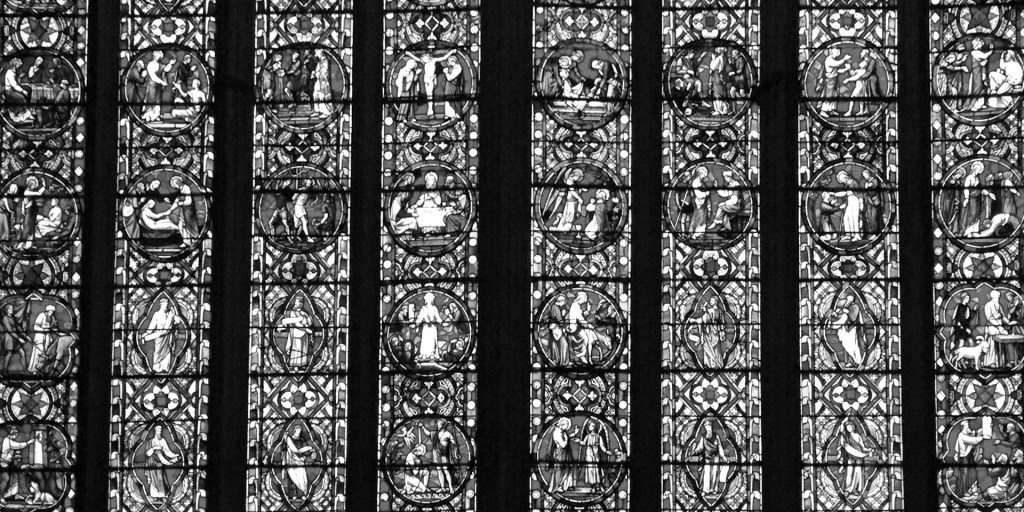
Robert Grosseteste died almost six centuries before the first daguerreotypes. He could have known neither photography, nor the physical theories that would connect the speed of light with the structure of space and time, nor the long debate over the nature of the photographic image. And yet, when I take a photograph, I very often find myself thinking of him.
This major English medieval philosopher, born between the end of the twelfth century and the beginning of the thirteenth, had an interest in light that gives him a distinctive place in the history of medieval thought. In three of his most original works, On Bodily Motion and Light, On Lines, Angles and Figures, and finally On Light, Grosseteste examines the nature of light in detail, from both a physical and a metaphysical perspective.
For Aristotle, light is fundamentally the actualisation of the transparent medium, the diaphanous. Grosseteste goes much further. In his cosmology, light is the first corporeal form. It is a metaphysical entity that, at the origin of the cosmos, joins unformed prime matter and expands it in every direction through its potentially infinite multiplication. In doing so, it carries matter with it and constitutes the extension of the physical universe itself. Hence, for Grosseteste, everything that exists in the sensible world is the result of the union of matter and light. Corporeality itself depends on the original action of light upon matter.
Light, however, does not always exist in the same mode. Grosseteste distinguishes two fundamental ways in which it is present. On the one hand, there is the light emitted by its own source: lux, the original light that propagates, multiplies, expands matter, and encounters bodies. On the other hand, there is lumen. This is derived light, received and diffused again by bodies. We might call it a secondary light, without considering it essentially different from lux. It remains light, although it manifests itself in a particular mode, determined by the characteristics of the body through which it passes or from which it is reflected.
Despite the obvious anachronism, I like to see here a distant analogy with the distinction between illuminance, luminance, and reflectance, which was so important to twentieth-century photographic theory and practice. Grosseteste clearly did not anticipate modern photometry, and photographic terminology cannot simply be superimposed upon his metaphysics of light. Analogies, however, can shift our perspective and reveal unexpected relations, provided that we do not mistake them for identities.
Let me play with these concepts for a moment. Illuminance could be compared to the effect of lux-light upon physical objects. It depends on the power of the light source, its distance, the direction of the light, and several external factors concerning what Aristotle and Grosseteste would have called the condition of the transparent medium. This medium is primarily air but – under particular conditions – it may also include water, vapour, dust, or any other element capable of modifying the propagation of light. Accordingly, illuminance concerns the light that reaches a body. It does not yet tell us how that body will appear. Different objects exposed to the same illumination do not return light in the same way: some absorb it almost entirely, others reflect it, others diffuse, filter, refract, or transform it.
Luminance could then be compared to lumen: the quantity of light that comes from an illuminated body and reaches the eye or the photographic sensor from a particular direction. In some cases, this light may be very intense while in others it may be barely perceptible. Yet wherever there is a light source and bodies capable of receiving its action, every object returns or transmits a certain quantity of light. This light is inseparable from the constitution of the object. It depends on its physical qualities, its surface, its density, and its capacity to absorb or reflect particular wavelengths. I would say that it depends on its materiality, although the matter involved here is already organised, determined, and qualified. In scholastic terms, it is secondary matter rather than prime matter.
Reflectance indicates the capacity of a surface to reflect a certain proportion of the light it receives. A concept of this kind is naturally absent from Grosseteste’s theory. Yet within the analogical exercise I am proposing, something similar is evoked by the role assigned to the particular characteristics of each body in the relation between lux and lumen. Original light encounters matter, and the light that results from this encounter is never a simple repetition of the incident light. It is light transformed through its encounter with a particular body.
From this perspective, each object seems to respond to light in its own way. Light does not simply show the object from the outside, as though the body were entirely passive: the visible appearance of the object arises from the interaction between the light that reaches it and its specific material constitution. What we see, and what the sensor records, is the result of this relation. Photography arises precisely within this relation. The sensor does not record the object in itself (whatever that might mean) but the light that reaches the photographic apparatus after crossing a space, encountering a surface, and being absorbed, reflected, or diffused. Photography records the luminous effects of its presence under particular conditions.
This distinction was fundamental to twentieth-century photography, when photographic practice often required a more explicit knowledge of exposure, the response of photosensitive materials, the qualities of light, and the characteristics of surfaces. Today, many of these operations are delegated to automatic and algorithmic processes. The apparatus calculates, corrects, compensates, and combines exposures. We can produce technically effective images without fully understanding how light has been translated into information. No hierarchy follows from this between computational photography, analogue photography, and more manual photographic practices. Nevertheless, a part of the conscious relation between photographer, light, object, and apparatus may become (and often is) opaque. The distinction between illuminance, luminance, and reflectance therefore retains a philosophical importance alongside its technical one. It reminds us that the image is the result of a series of transformations. It is never a simple duplication of reality.
At the same time, there is a further level, and this may be the main reason why I think of Grosseteste when I photograph. In several powerful passages, still debated by scholars today, Grosseteste argues that light provides the geometrical model according to which natural changes occur and also acts as the driving force behind every bodily transformation. The propagation of light through lines, angles, and figures makes it possible to understand the operation of natural causes. This is one of the earliest systematic attempts to geometrise nature in the history of Western thought. Grosseteste’s thesis is complex and controversial. I have worked on these problems in my research, trying to reconstruct their meaning within medieval natural philosophy. Here, however, I want to leave their historical and metaphysical context aside and play once again with Grosseteste and the experience of photography.
Whenever we take a photograph, whether documentary or artistic, made in the street or in a studio, we enter a network of relations among entities and establish new ones. There is a relation between the photographer and the scene, mediated by the photographic apparatus and by the decision to turn that scene into an image. There is a relation between the photographer and those who will see the photograph, since the image selects, organises, and communicates a possible content. There is a relation between lux-light, lumen-light, and the sensor, mediated by the lens, exposure time, aperture, software, and the entire technical system of the camera. There is also a relation between the apparatus and the photographer who uses it, assuming that they can truly be treated as two completely separate agents: photography emerges from a form of action distributed between human intention and technical operation. Finally, there are the relations among the elements of the scene itself: bodies, objects, surfaces, distances, directions, gestures, gazes, and areas of light and darkness. Photography selects these relations, excludes some, emphasises others, and creates new ones through the frame.
When we consider the photograph as an entity in its own right, this system of relations becomes decisive: the meaning of the image arises from its particular organisation. A photograph is certainly an artefact. Using scholastic vocabulary, a photo is the product of an artificial form that first exists in the mind of the artifex, much as the photographic image is previsualised in the mind of the photographer. Once produced, a photo possesses an existence of its own, relatively independent of the photographer-craftsman who caused it. In other words, like a table, a vase, or a house, the photograph continues to exist and to act in the absence of its author.
Photography normally presents itself as the freezing of a temporal instant. This remains true when that instant is extended through a long exposure, composed from different images, digitally reconstructed, or entirely fabricated. In all these cases, the image still tends to present what it shows as a unified configuration, apparently removed from the flow of time. Yet what has been frozen is never completely static. That instant, whether authentic or constructed, always refers to an event. An event takes place in time and, for this reason, it necessarily involves an interaction. Something acts (actio), something undergoes an action (passio), something changes or could change. The Aristotelian terminology of action and passion may seem distant from the way we usually speak about photography. Yet it allows us to perceive an essential aspect of the photographic image: every scene consists of subjects, objects, and relations that affect one another. Even when nothing seems to be happening, the scene remains the result of a dynamic network of reciprocal interactions, including many that cannot be directly perceived. Consider, for instance, the radical case of a studio portrait with no background and only the subject standing before the camera. Even this involves an event. There is the context of the pose, the relation with the photographer, what the two have said or left unsaid, what happened to each of them that day, the day before, and throughout the course of their lives.
It is this event, composed of actions, passions, and relations, that the photograph freezes. It does not preserve change throughout its entire duration but retains a temporary configuration of that change. The image shows how different elements entered into relation at a particular moment and from a particular perspective. Light makes this recording possible. As lux, it reaches bodies, crosses space, and establishes the conditions of their visibility. As lumen, it is returned by bodies according to their characteristics, transformed by matter, and directed towards the eye or the sensor. Within the photographic apparatus, this light is then converted into a chemical trace or an electrical signal, into numerical data and code, and finally back into a visible image.
Photography is the result of a long chain of mediations: at each stage, something is preserved, something is transformed, and something is lost. Hence, it is impossible for photography to return the event either directly or in its entirety. Yet it preserves a selective trace produced through the encounter between world, light, apparatus, and intention. Therefore, the event, understood as an interweaving of actions, passions, and changes, is present in every photograph, regardless of the specific features of the individual shot.
Photography is the result of a long chain of mediations: at each stage, something is preserved, something is transformed, and something is lost. Therefore, photography can return neither the event directly nor the event in its entirety. It preserves instead a selective trace produced through the encounter between world, light, apparatus, and intention. The event, understood as an interweaving of actions, passions, and changes, remains present in every photograph through this trace, regardless of the specific features of the individual shot. Light makes the event visible and carries to the photographic apparatus a trace of the relations and transformations that constitute it.
Within the freedom of the analogy with Grosseteste, light is at once a principle of change and the proximate cause by which that change becomes photographic testimony. We are now far from Grosseteste, of course. It would make little sense to turn him into a theorist of photography before its invention, or to search his texts for direct answers to questions that arose many centuries later. Yet his thought still offers a conceptual framework capable of accompanying the experience of photography. This is why, when I take a photograph, I often think of light as the form of bodies, of its propagation through space, and of the way it encounters matter and is transformed by it. I think of light as a condition of change and of photography as an attempt to retain, for an instant, the configuration produced by that change.
Photography is certainly modern. It depends on technologies, materials, and theories that Grosseteste could never have imagined. Yet the gesture that sustains it is far older: following light, observing how it crosses the world, and trying to understand how illuminated things temporarily become what they appear to us to be.
Latest update: July 2026
 Hylonicum